
Link Insertion Services
Instead of creating a brand-new article, link insertion means finding existing, already-published, and already-ranking content on relevant websites and asking (or paying) the site owner to add your link naturally within that content. Because the host page is already indexed, already has some authority, and often already ranks for relevant keywords, the link you insert can pass value almost immediately — without the overhead of producing fresh content for every single placement.
We are breaking down what link insertion is, why it works, how to execute it properly, and how to avoid the pitfalls that can turn a smart shortcut into a liability.
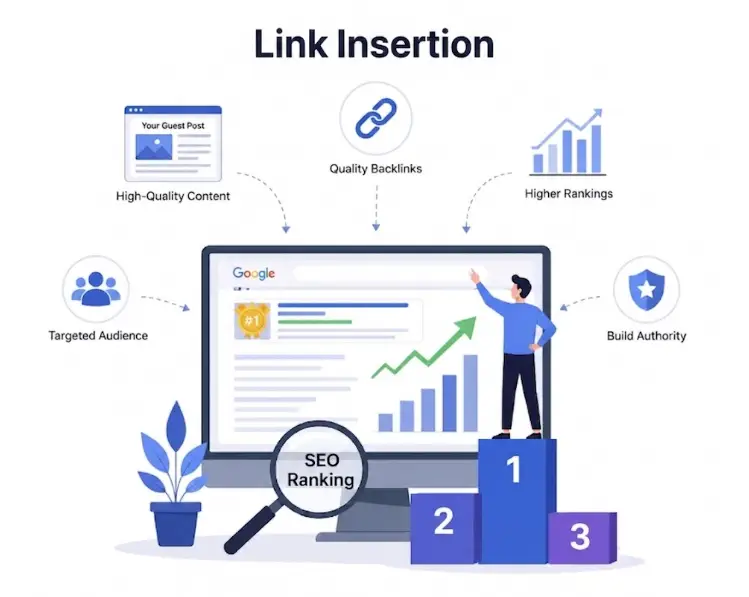
What Is Link Insertion?
Link insertion is the practice of adding a hyperlink into a piece of content that already exists and is already published on someone else’s website. Rather than writing a new post for a “backlink slot,” you identify content that’s topically relevant to your target page, then work with the site owner (directly or through an agency/marketplace) to insert your link into a specific sentence or paragraph.
For example, if you run a project management SaaS tool and you find a two-year-old blog post titled “10 Productivity Tips for Remote Teams” on a mid-authority business blog, you might request that the sentence mentioning “time-tracking software” be updated to include a link to your product page.
The appeal is straightforward:
- No content creation cost on your end for the host article.
- Faster turnaround — insertion often happens within days, not weeks.
- Leverages existing authority — the page may already have backlinks, social shares, and search rankings of its own.
- Contextual relevance — when done well, the link fits naturally into a passage the reader is already engaged with.
Why Link Insertion Works So Well
“A good link is someone who comes across your website and thinks it’s a fantastic website and recommends it to other people with a link.”
- John Mueller -
1. It Taps Into Established Authority
A newly published guest post starts from zero. It has no backlink history, no traffic, and no trust signals of its own — everything it “earns” comes only from the domain hosting it. An existing article, on the other hand, may have been live for months or years. It could already have inbound links from other sites, natural social shares, and a stable position in search results. When your link is inserted into that page, it inherits a slice of that established equity immediately.
2. Search Engines Favor Contextual Relevance
Google’s algorithms weigh not just the number of backlinks but also their context—the surrounding text, the topical relevance of the linking page, and how naturally the link fits into the content. A link inserted into a genuinely relevant paragraph on a well-aligned page sends a stronger relevance signal than a link buried in a generic, hastily written guest post that exists purely as a link vehicle.
3. Efficiency at Scale
For SEOs managing link building across dozens or hundreds of target pages, writing a unique, high-quality guest article for every single placement is not sustainable at scale. Link insertion allows a leaner team to secure meaningful placements faster, freeing up resources to focus on content strategy, technical SEO, or other growth levers.
4. Diversification of the Link Profile
A backlink profile built entirely from one tactic (all guest posts, all directory links, all press releases) can look unnatural to search engines. Mixing in insertions on older, organically ranking content adds variety to link timestamps, anchor text distribution, and referring domain types—all of which contribute to a more organically ranking profile.
The Core Components of a Strong Link Insertion Strategy
1. Target Page Selection
The single most important variable in link insertion is where your link ends up. A poorly chosen placement — on a thin, irrelevant, or spammy page — can do more harm than good. When evaluating potential host pages, look at:
- Topical relevance: Does the article’s subject matter genuinely relate to your target page? A finance blog linking to a cybersecurity tool is a stretch; a cybersecurity blog linking to the same tool is a natural fit.
- Domain authority and trust metrics: While no single third-party metric perfectly mirrors Google’s internal scoring, tools that estimate domain authority, referring domains, and organic traffic can help you triage opportunities.
- Existing organic traffic: A page that already ranks and receives search traffic is more valuable than one that’s indexed but dormant, because it suggests Google considers the page useful and trustworthy.
- Content quality and age: Well-written, well-structured, evergreen content ages better as a link host than thin or outdated posts nobody reads anymore.
- Outbound link profile: If a page already links out to a dozen unrelated commercial sites, it may be an established “link farm” post, and adding your link there provides little value and some risk.
2. Anchor Text Strategy
Anchor text — the clickable words in a hyperlink — remains one of the strongest relevance signals search engines use to understand what a linked page is about. But over-optimized, exact-match anchor text across many links is also one of the clearest fingerprints of manipulative link building.
A sound approach mixes the following:
- Branded anchors (e.g., “Acme Software”) — the safest and most natural type.
- Naked URL or generic anchors (e.g., “this tool,” “click here,” “the website”) — mimics organic linking behavior.
- Partial-match anchors (e.g., “a project management platform like Acme”)—provides topical context without being an exact keyword match.
- Exact-match anchors (e.g., “best project management software”)—useful in small doses, but should represent a small minority of your overall anchor profile.
3. Placement Within the Content
Where inside the article your link sits matters. Links placed within the main body of the text — particularly early or mid-article, within a sentence a reader is actually likely to read — tend to carry more weight than links buried in a footer, sidebar, or “further reading” list at the very bottom.
Ideally, the sentence surrounding the link should:
- Reference the topic your target page covers, not just contain a shoehorned keyword.
- Read as if it were part of the original writer’s voice, not an obvious insertion.
- Add genuine value to the reader — a legitimate resource, data point, or tool recommendation, not just a link for link’s sake.
4. Outreach and Relationship Building
Because you’re asking someone to modify an already-published page, outreach for link insertion requires a slightly different pitch than a guest post request. Effective outreach typically:
- Identifies a specific, existing sentence or section where the link would add value (not a vague “can I get a link on your site” ask).
- Offers something in return — this might be payment (common in niche-edit marketplaces), a reciprocal resource, an updated statistic or broken-link fix, or simply a well-reasoned case for why the addition benefits their readers.
- Is personalized. Mass-templated outreach emails referencing “your great website” without specifics are easy to spot and typically ignored or flagged as spam.
- Respects editorial control. Reputable publishers will often decline or modify your suggested wording — building goodwill for future placements means accepting reasonable edits.
5. Vetting for Safety and Quality
Not all link insertion opportunities are created equal, and some marketplaces and vendors sell placements on networks of low-quality or even artificially inflated sites. Before committing to any placement or bulk package, check:
- Whether the site has real organic traffic (not just backlink metrics that can be manipulated).
- Whether other outbound links on the same page look natural, or whether the page is stuffed with unrelated commercial links (a sign of a “link farm”).
- Whether the site’s content is genuinely useful to human readers or exists purely to host paid links.
- Whether the vendor discloses that placements are paid—using undisclosed paid links at scale carries risk if patterns are detected.