Guest Post Services
We provide professional link-building services that help businesses strengthen their online authority, earn high-quality backlinks, improve search engine rankings, and achieve sustainable SEO growth for local and global markets.
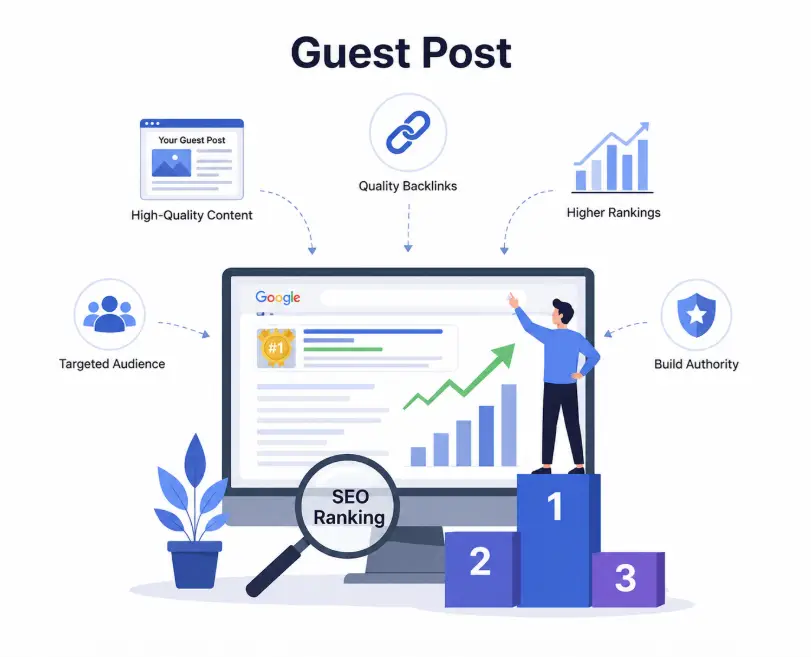
Guest posting — writing content for someone else’s blog or website — remains one of the most effective, low-cost strategies for building brand authority, earning quality backlinks, and reaching new audiences. Despite years of predictions that guest blogging is “dead,” it continues to thrive because it solves a problem that both writers and publishers share: publishers need fresh, valuable content, and writers need visibility in front of an audience they haven’t yet built themselves.
Crafting a Pitch That Gets a Yes
Editors are busy, and most receive far more pitches than they can accept. A strong pitch respects their time and demonstrates you understand their audience. Personalize every outreach email, mention why your topic fits their website, and explain the value it will provide to their readers. Avoid generic templates that are sent to hundreds of websites. Instead, focus on building genuine relationships with editors by being professional, concise, and helpful. A thoughtful guest post pitch increases your chances of acceptance, leading to high-quality backlinks, stronger online authority, and long-term SEO success for your business. Here’s a structure that works:
Personalize the opener
Reference a specific article you enjoyed and why. This immediately signals you’ve actually read the site rather than mass-blasting a form email.
Propose 2–3 specific headline ideas
Not a vague topic area. “I’d love to write about marketing” is forgettable. “3 Guest Posting Mistakes That Are Quietly Hurting Your SEO” is a headline an editor can picture on their site.
Explain your unique angle
Why are you the right person to write this? A sentence or two of relevant credentials or experience goes a long way.
Include writing samples
Link to two or three of your best previously published pieces, ideally ones similar in tone or topic to what you’re pitching.
Keep it short
A pitch email should rarely exceed 150–200 words. Editors decide quickly; make it easy for them.
Follow the guidelines exactly
If a site has published contributor guidelines, follow them to the letter—word count, formatting, and submission process. Ignoring published guidelines is one of the fastest ways to get an automatic rejection.
Writing a Guest Post That Actually Gets Published
Once you land the yes, the real work begins. A great guest post shares several traits:
It matches the publication’s voice. Read several recent articles on the site before you write a single word. Is the tone conversational or formal? Do they use first person? How long are paragraphs typically? Mirroring these conventions makes an editor’s job easier and increases your odds of acceptance.
It leads with value, not self-promotion. The biggest mistake new guest writers make is treating the post as a thinly veiled advertisement. Editors and readers can spot this instantly, and it damages your credibility rather than building it. Save the self-promotion for your author bio; the article itself should be genuinely useful, insightful, or entertaining on its own merits.
It’s well-structured. Use clear subheadings, short paragraphs, and — where relevant — bullet points or numbered lists. Online readers scan before they commit to reading in full, so structure needs to support that behavior.
It backs claims with evidence. Data, examples, case studies, and expert quotes make an article credible and shareable. Vague generalizations (“many businesses struggle with X”) are far less persuasive than specifics.
It has a natural, non-spammy link. Most publications allow one or two contextual links back to your site, usually within the body copy or the author bio. The link should feel like a natural resource for the reader, not a forced insertion. Avoid exact-match anchor text stuffed with keywords — it reads as manipulative to both readers and search engines.
It ends with a clear takeaway. Readers should walk away from your post knowing exactly what they learned or what to do next.
Common Guest Posting Mistakes to Avoid
-
- Pitching without reading the site. Editors can tell within a sentence whether you’re familiar with their publication.
-
- Writing generic, recycled content. If your post reads like fifty other articles already on the internet, it won’t get accepted — and if it does, it won’t perform.
-
- Over-optimizing for keywords. Guest posts written primarily to manipulate search rankings tend to read poorly and are increasingly filtered out by both editors and algorithms.
-
- Ignoring the follow-up. Once published, share the post on your own channels, respond to comments, and thank the editor. This builds the relationship for future opportunities and shows respect for the platform that published you.
-
- Chasing volume over quality. Ten guest posts on low-authority, low-relevance sites are worth far less than two guest posts on sites your actual audience reads.
-
- Forgetting to disclose paid arrangements. If a placement is paid or sponsored, ethical and often legal obligations require disclosure. Skipping this erodes trust with both the publication and readers.
Measuring the Impact of Your Guest Posts
Because guest posting has multiple potential benefits, it’s worth tracking more than one metric:
-
- Referral traffic — how many readers actually click through to your site from the post
-
- Backlink quality — check whether the link is indexed and passing authority using an SEO tool
-
- New subscribers or followers attributable to the post’s publish date
-
- Search ranking movement for relevant keywords over the following weeks and months
-
- Relationship outcomes — did the placement lead to further collaboration, an invitation to contribute again, or an introduction to someone else in the niche?
Guest posting rarely produces an overnight spike. Its value tends to compound: each well-placed post adds a small amount of authority, a handful of new readers, and one more relationship — and these effects stack over months and years of consistent effort.