
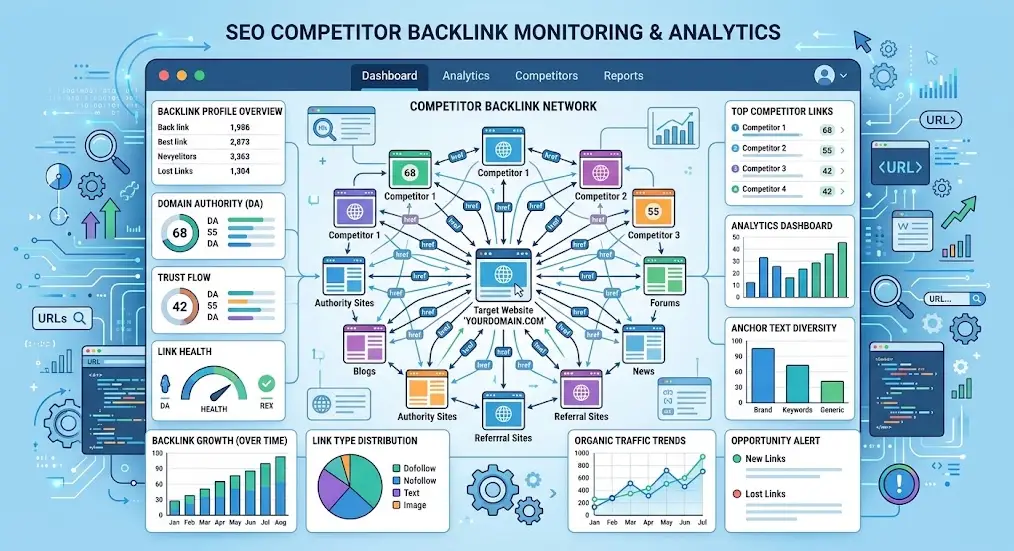
In search engine optimization, off-page authority remains one of the strongest ranking signals evaluated by search algorithms. While on-page optimization and technical site health lay the foundation, high-quality backlinks act as essential votes of confidence that propel web pages to the top of the Search Engine Results Pages (SERPs). However, blind link-building without a clear strategy often results in wasted resources and low conversion rates.
Monitoring competitor backlinks bridges this gap by turning search intelligence into a repeatable, high-ROI workflow. By reverse-engineering where rival sites earn their authority, digital marketers and SEO professionals can uncover pre-validated link prospects, spot emerging industry trends, and systematically close domain authority gaps.
1. Why Competitor Backlink Monitoring is Critical for Modern SEO
Building backlinks from scratch without competitive intelligence is like navigating without a map. Competitor backlink monitoring delivers several core benefits:
- Shortcutting Prospect Discovery: Instead of manually searching for websites in your niche that might link to you, competitor analysis reveals sites that already link to similar content.
- Understanding Link Velocity: Tracking how fast competitors acquire new links helps establish realistic monthly outreach benchmarks for your own growth.
- Detecting Strategy Shifts: When a competitor suddenly gains dozens of links from podcasts, guest posts, or digital PR campaigns, monitoring alerts you immediately so you can adjust your tactics.
- Protecting Market Share: Early awareness of a rival’s aggressive link campaign allows you to defend key commercial pages before losing rank position.
| Objective | Traditional Outreach | Competitor-Based Outreach |
| Prospect Match Rate | Low to Moderate | High (Pre-vetted interest) |
| Response Rates | ~2%–5% | ~8%–15%+ |
| Resource Efficiency | Requires heavy filtering | Direct target acquisition |
2. Setting Up Your Competitor Intelligence Workflow
Before diving into backlink data, identify your true Search Competitors. Your direct business rivals (e.g., local competitors) might not be the same websites ranking above you on Google for core commercial terms.
Step 1: Identify Search Competitors
- Open an incognito browser window or use an SEO tool.
- Search for 5–10 primary transactional and informational keywords.
- Document the top 3–5 domains consistently ranking on page one.
Step 2: Establish Metric Baselines
Track core authority metrics across your competitor cohort using major SEO platforms (such as Ahrefs, Semrush, or Moz):
- Domain Rating / Authority Score: Overall domain strength.
- Referring Domains (RD): Total count of unique websites linking to the domain.
- Dofollow vs. Nofollow Ratio: Healthy mix indicates natural growth.
3. The Backlink Gap Analysis: Uncovering High-Value Opportunities
A Backlink Gap Analysis reveals referring domains that link to two or more of your competitors, but not to your site.
When an external site links to multiple competitors, it signals that the editor or webmaster is actively interested in your specific niche. Getting placed on these sites often requires minimal convincing if you offer superior content or updated statistics.
How to Conduct a Gap Analysis:
- Load your site alongside up to 4 primary competitors into a link gap tool.
- Set filters to “Intersecting Links” or “Sites linking to rivals, but missing me”.
- Sort the resulting domains by metric scores (e.g., Domain Authority / Authority Score).
- Tag targets into tactical outreach buckets: Resource Pages, Listicles, Guest Posts, or News Outlets.
4. Executing Competitor Backlink Replicating Strategies
Once you have a list of targets, apply targeted outreach frameworks to secure placements:
1. Broken Link Building
Identify broken pages (404 errors) on competitor sites that still possess active incoming backlinks. Reconstruct similar or better resources on your site, then notify the webmaster about the dead link while presenting your resource as a working replacement.
2. The Skyscraper Technique
Analyze your competitors’ most linked-to pages. Create a piece of content on the same topic that is noticeably more comprehensive, updated, or visually appealing. Reach out to sites linking to the original piece and pitch your updated version.
3. Unlinked Brand & Mention Reclamation
Monitor mentions of competitor products, founders, or original research. If an article references a competitor tool or stat alongside generic industry commentary, offer your site as an additional or updated source.
5. Automation, Alerts, and Long-Term Maintenance
Manual checking is time-consuming and risks missing rapid strategic moves. Set up automated email alerts in your preferred SEO suite:
- New Backlink Alerts: Get notified weekly when a key rival earns high-authority links.
- Lost Backlink Tracking: Monitor when a competitor loses a link. If a link broke or a page was deleted, reach out immediately to claim that spot.
- Quarterly Audits: Re-run domain gap reports every quarter to adjust to market changes and track authority growth.
By systematically analyzing competitor backlink profiles, converting findings into actionable outreach targets, and maintaining ongoing monitoring, you transform search engine rankings from a guessing game into an engineered science.
Learn more about performing competitor backlink analysis to boost rankings in this video guide: How To Do Competitor Backlinks Analysis To Rank #1 on Google
This video offers a step-by-step breakdown of how to analyze competitor backlink profiles and uncover high-value link prospects.



Leave a Reply